
The problem is that almost everything written about choosing an island is written for divers. Ask which island is best and the answer comes back in dive sites, certifications and depths. If you have no intention of putting on a tank, that is a different question with a different answer.
Here is the non-diver's version.
What you can actually see without diving
More than most people expect, and this is not a consolation prize.
- Manta rays
- Feed near the surface. Watching one from above, at snorkelling depth, is arguably better than watching one from below: you see the whole shape against the light.
- Turtles
- Surface to breathe. They feed in shallow seagrass and on reef tops. Snorkellers see turtles constantly.
- Nurse sharks
- Rest in shallow water. They are large, slow and completely uninterested in you.
- Reef fish and coral
- At their most colourful in the top few metres, because that is where the light is. Deeper is not more beautiful; it is just deeper.
- Whale sharks
- In the parts of the country where they pass, they are surface feeders. Whale-shark trips are snorkelling trips.
What you miss without diving is real but specific: wrecks, channels, deeper pinnacles, hammerheads at depth, and the ability to stay down. If none of that was your reason for coming, you are not missing the Maldives. You are missing part of the diving.
No certification is needed to snorkel. If you can swim and put your face in the water, you are qualified.
The two things that actually matter when you choose
For a non-diver, most island comparisons are answering the wrong questions. These are the two that decide your trip.
Can you snorkel from the shore?
This is the big one, and it varies enormously between islands that otherwise look identical.
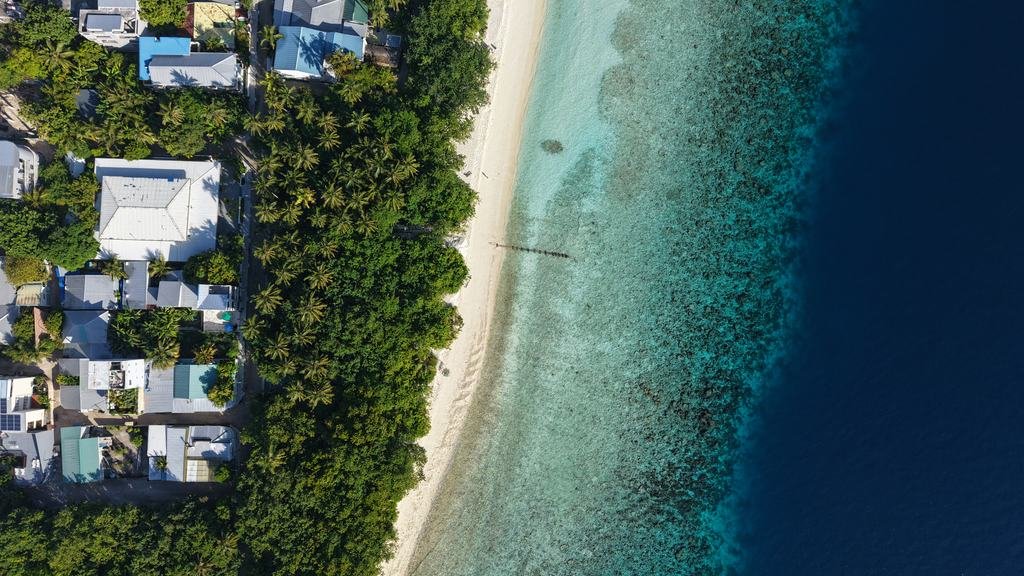
Some local islands have a house reef close enough to swim to. You walk down, put a mask on, and you are over coral in ten minutes without a booking or a boat or a payment. Over a week that is the difference between snorkelling once and snorkelling every day.
Others have a lovely beach and a lagoon that runs shallow and sandy for a long way, where the good reef is a boat ride out. Perfectly nice islands. A different holiday.
Ask directly: how long does it take to swim to the reef, and is there current? A guesthouse that answers with a real number knows its own water.
Are the boat trips built for snorkellers?
Some excursions are dive trips that will drop snorkellers at the surface. Others are designed for people on the surface from the start: sites chosen for visibility and depth rather than for what is at forty metres, and a guide who stays in the water with you.
The second is much better and it is not always obvious which you are booking. Ask whether the trip is a snorkelling trip or a dive trip with snorkellers attached.
The islands, from a non-diver's point of view
Five commonly considered local islands, judged only on this.
- Ukulhas
- The house reef is close enough to swim to from the beach, which is the specific reason it suits snorkellers. The atoll around it is manta and nurse-shark water. If your criterion is “reef without a boat”, this is the island's whole argument. Our own excursion is a snorkelling trip, not a dive trip.
- Dhigurah
- Snorkelling straight off the beach is well regarded, and the island sits in the part of the country where whale sharks are most reliably found. For a non-diver specifically wanting a whale shark, this is the strongest choice on the list, and whale-shark trips are surface trips.
- Thoddoo
- Known for turtles off the bikini beach without a boat, which is a very good non-diver credential. A long, wide, uncrowded beach as well.
- Rasdhoo
- The most dive-led of the five. Its reputation rests on dive sites and on animals found at depth. A non-diver will have a good time and will not be getting the thing the island is famous for.
- Maafushi
- Snorkelling is more limited from the shore, but the excursion market is the biggest and cheapest in the country because so many operators compete. If your plan is boat trips rather than swimming out, that is a real advantage.
The five islands compared on everything else.
A week that never involves a tank
What a non-diving Maldives week actually looks like, so you can judge whether it is enough.
- Snorkelling off the beach
- As often as you feel like it, at no cost. On an island with a house reef this becomes the default morning activity.
- One or two boat trips
- To the places where the bigger animals gather. This is where manta rays, nurse sharks and turtles happen.
- A sandbank
- A bank of sand in open water with nothing on it. Unexpectedly the favourite part for a lot of people.
- Sunset fishing
- Traditional line fishing, and popular with people who did not think they wanted to go fishing.
- Island hopping
- If you want to see somewhere other than where you are.
- Beach
- The actual point, for many people, and the thing that gets least attention in content written by divers.
That is a full week without any of it requiring a certification, and the expensive part is one or two boat trips rather than a course.
Is it worth learning to dive while you are there?
Sometimes, and it is worth being honest about when.
Worth it if you were curious anyway, you have a week or more, and you would happily give two or three days of it to a course. Many local islands have dive centres — Ukulhas has seven for an island you can walk across — and a certification is portable.
Not worth it if you came to relax, or your trip is short, or you are only considering it because you have read that diving is the real Maldives.
It is not. The animals people travel here for are visible from the surface. A course costs days and money that could go into more time on the water.
Practical things for snorkellers
- Bring your own mask if you are particular.
- Rental masks fit whoever had them last. If you are going in the water daily, your own mask is the single best thing you can pack.
- Reef-safe sunscreen, and a rash vest.
- Floating face-down for an hour burns your back in a way you do not notice until later. A long-sleeved top is more reliable than sunscreen and does not go on the reef.
- Do not stand on coral.
- It is alive, it is slow-growing, and a fin kick breaks years of it.
- Keep your distance from the animals.
- Manta rays leave if you swim at them. The people who see the most are the ones who stay still.
- Know your swimming honestly.
- Open water is not a pool. Currents move. Say so in advance if anyone in your group is not a confident swimmer, and a good operator will plan around it rather than sort it out at the jetty.
Frequently asked questions
Can you see manta rays in the Maldives without diving?
Yes. Manta rays feed near the surface and manta trips are commonly snorkelling trips. Sightings are never guaranteed, on any trip.
Do you need a licence to snorkel in the Maldives?
No. No certification is required to snorkel anywhere in the country.
Which Maldives local island is best for snorkelling from the beach?
Ukulhas, Thoddoo and Dhigurah all have reef reachable by swimming from shore. Thoddoo is specifically known for turtles off the bikini beach; Ukulhas for a house reef close to shore.
Can you see whale sharks while snorkelling?
Yes. Whale sharks are surface feeders and whale-shark excursions are snorkelling trips. South Ari Atoll is where they are most reliably encountered.
Is the Maldives worth visiting if you do not dive?
Yes. The reef, the beaches, the boat trips and most of the large marine life are all accessible from the surface. Diving adds depth, wrecks and time underwater.
Do I need a boat to see anything good?
Not on an island with a house reef. You will want a boat for the manta and nurse-shark areas, which are not usually swimmable from shore.
Are snorkelling trips suitable for weak swimmers?
It depends on the site and the operator. Say so in advance. A trip planned around a nervous swimmer is fine; a trip that discovers one mid-ocean is not.