

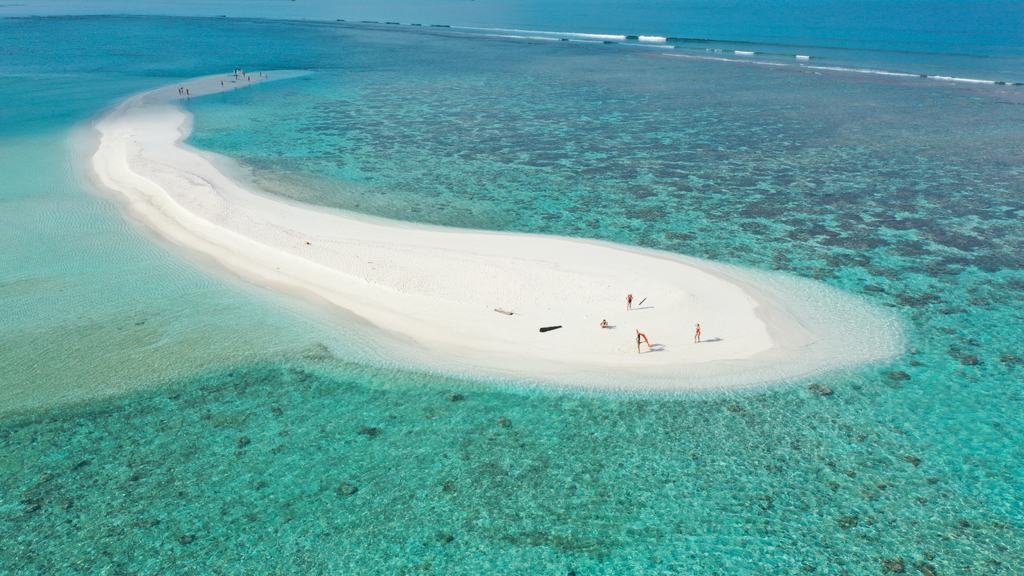
Island hopping is genuinely worth it when the islands do different things: diving on one, beach on another, a resort finish. It is not worth it when the islands are broadly similar and the reason for moving is that an itinerary said three sounded better than one.
Here is how to work out which you are doing.
What a move actually costs
The published cost of moving is a boat fare. The real cost is a day, and it is worth seeing where it goes.
- The morning is gone before you leave.
- Boats from local islands run early. On Ukulhas the departures are 07:00 and 13:00, and the equivalents elsewhere are similar. You are packing and checking out rather than swimming.
- The crossing itself.
- An hour to two hours between local islands, depending where you are going and whether it is direct.
- The afternoon goes to arriving.
- Check-in, finding where things are, working out where to eat, buying water. On your first island this is part of the fun. On your third it is admin.
- Two half days, minimum, per move.
- That is the honest figure. On a seven-night trip with two moves you have spent two of your seven days in transit and orientation.
And you lose the flexibility that matters most. This is the part people do not anticipate. Weather in the Maldives is local and changeable. If you are on one island for six nights and Tuesday morning looks poor, you go out on Wednesday instead. If you are on a tight hopping schedule, Tuesday was the only morning that island had, and the trip you came for does not happen.
That single point is why we push longer single-island stays. It is not that moving is bad. It is that moving removes your margin.
By trip length
Three nights: one island, obviously
You have two clear days. Your first is mostly the flight and the crossing, and your last morning belongs to the boat back. A move would consume most of what you have.
Pick one island and do one thing properly. What three nights actually gives you.
Six nights: one island for most people
Six nights on one island gives you five clear days. That is enough to have a proper ocean morning, a day on the reef, a beach day, and a day where nothing is planned, plus a spare morning if the weather turns.
Split that across two islands and you have two three-night stays, one of which has a travel day inside it. You will have seen more places and done less.
The exception is a genuine contrast. Six nights as three on a diving island and three on a beach island is a real itinerary, because you are buying two different things. Six nights as three on one quiet local island and three on another quiet local island is not; you are buying the same holiday twice with a boat in the middle.
Nine nights: a real argument either way
At nine nights the arithmetic changes. One move costs you about a day out of nine, which is affordable.
Stay on one island if you want the trip to slow down. Somewhere around day four an island stops being a place you are visiting. You know which café you prefer and which end of the beach is quiet after lunch, and that is a specific pleasure you cannot get in three-night blocks.
Split it if you want two genuinely different experiences: a local island and then a resort, or a snorkelling island and a diving island, or two different atolls. Five nights and four is a better split than three and three and three.
Two weeks or more: hop, but not much
With fourteen nights you can comfortably do two islands and possibly three. More than that and you are travelling rather than holidaying. The commonly repeated guidance — at least three nights per base, no more than about four islands in two weeks — is sound, and if anything three islands in fourteen nights is plenty.
When island hopping is the right answer
We are not against it. It is right when at least one of these is true.
- The islands genuinely differ.
- South Ari for whale sharks and North Ari for reef is a real reason. Two similar islands in the same atoll is not. Bear in mind that no island guarantees a sighting, so building a whole trip around one animal carries a risk wherever you stay.
- You want a resort finish.
- Several nights on a local island then a few at a resort is one of the best-value Maldives trips available, and it gives you both things the country does well. The local island costs a fraction of the resort, so the average holds down while you still get the overwater night.
- You are staying a long time.
- Beyond two weeks, one small island will start to feel small. That is not a criticism of the island.
- You are travelling to see the country, not to rest.
- Perfectly valid. Just be honest that it is a different trip from the one people picture when they imagine the Maldives.
- Someone else is doing the logistics.
- An organised multi-island trip removes most of the friction described above. It costs more.
When it is the wrong answer
- When the reason is fear of missing out.
- Three islands on an itinerary looks better than one. It does not feel better while you are packing for the second time.
- When your trip is under a week.
- The arithmetic simply does not work.
- When the marine experience is the point.
- Wildlife needs weather, and weather needs flexibility, and flexibility needs time in one place.
- When you are travelling with small children.
- Every move is a full pack-up. Two is plenty; three is a job.
- When your flights are tight at either end.
- The Maldives arrival and departure schedule is the least forgiving part of the trip. Adding internal moves adds places for it to go wrong. How flight times affect your transfer.
The one logistical thing to check first
If you do move between local islands, check how you get between them before you book either stay.
Not all local islands connect directly to each other. Some connections run through a hub island, and some run through Malé, which means going back the way you came. The public ferry network is cheap but infrequent and does not run every day on every route. Speedboat transfers between islands exist but are not always scheduled the way you need them.
The failure mode is booking two lovely islands and discovering the only connection is a day-long detour or a private charter. Ask both guesthouses how people actually get between them, and ask before you pay for anything.
Frequently asked questions
How many Maldives local islands should I visit in a week?
One, for most people. Seven nights split across two islands leaves you two three-night stays with a travel day inside one of them. Two islands works better at ten nights or more.
Is island hopping in the Maldives worth it?
It is worth it when the islands offer genuinely different things, such as diving versus beach or local island versus resort, and when you have the days to absorb the moves. It is not worth it as a way of seeing more of a country whose local islands are, from a visitor's point of view, fairly similar to each other.
How long does it take to move between local islands?
Usually one to two hours on the water, but the practical cost is closer to a full day once you account for early departures, check-out, check-in and orientation.
What is the minimum stay per island?
Three nights. Below that you spend more of the stay arriving and leaving than being there.
Does staying longer on one island get cheaper?
It should. Most guesthouses discount longer stays, and you stop paying for transfers between islands. Ours are priced that way deliberately — the longer you stay, the less each night costs.
Can I do a local island and a resort in one trip?
Yes, and it is one of the best-value structures available. Several nights on a local island then a few at a resort gives you both, and holds the average cost down. How to compare what a trip actually costs.